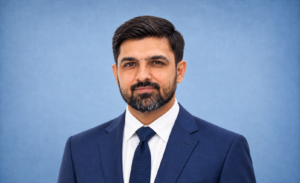
As education evolves toward more personalized and accessible learning, individual attention remains essential to meaningful student development. In this conversation, Abdul Rehman shares how Tutor on the Way is complementing conventional education through structured one-on-one tutoring, technology, and thoughtful tutor matching, helping students receive support tailored to their unique learning needs.
Boardroom: What inspired you to create Tutor on the Way?
Abdul Rehman: The idea for Tutor on the Way came from observing a persistent gap in the education system, particularly among students at the secondary school level. Through my experience of working with students, I realized that many learners require more individual attention than conventional classroom environments can provide. A teacher in a classroom has to address the needs of many students simultaneously, while every student has a different pace, learning style and level of understanding. At the same time, many parents, particularly those living busy lives in metropolitan areas, struggle to provide consistent academic support at home. Tutor on the Way was conceived to address this gap by bringing personalized, one on one learning closer to students and parents through a structured and accessible platform.
Boardroom: So, what challenge in Pakistan’s education system are you addressing?
Abdul Rehman: One of the major challenges is not simply the availability of education, but the consistency and quality of individual attention. A student may attend a good school and still struggle with particular subjects or concepts because the classroom environment cannot always accommodate individual learning needs. Home tuition has traditionally attempted to address this problem, but it can be inconsistent, difficult for parents to manage and dependent on finding the right tutor. There is also a considerable difference in the quality and value delivered by individual tutors. Tutor on the Way aims to create a more organized alternative by connecting students with appropriate tutors while providing a more structured learning experience. We are not trying to replace schools or existing educational institutions. Rather, we want to complement them by addressing the personalized learning needs that are often difficult to accommodate within conventional systems.
Boardroom: How does personalized learning provide improved student outcomes?
Abdul Rehman: Personalized learning allows the educational experience to respond to the individual student rather than expecting every student to learn in exactly the same way. Some students need additional explanation, some require more practice, while others may benefit from a different method of presentation. One on one learning creates an environment in which a tutor can identify a student’s weaknesses, understand their pace and adapt the teaching approach accordingly. This can be particularly valuable for students who hesitate to ask questions in a classroom or need additional support before they can progress confidently. Our objective is therefore not simply to provide another tuition service. It is to make learning more responsive and customized, so that students receive support according to their actual academic requirements.
Boardroom: How much is home tuition?
Abdul Rehman: The cost of conventional home tuition can vary significantly depending on the tutor, subject, location and level of the student. This creates another challenge for parents because they may have to make a choice between affordability and quality. Our objective is to make quality one on one education more financially accessible. We want parents to have meaningful choices rather than assuming that personalized education must always be expensive. The platform model also allows us to think beyond the traditional structure of home tuition and explore ways in which technology can make quality education more accessible while maintaining the value of personal interaction between student and tutor.
Boardroom: When you meet a very diverse audience, how do you see the future of one-on-one learning?
Abdul Rehman: I believe one on one learning will remain important because education is ultimately about individual development. Technology and large educational institutions can make knowledge more accessible, but they cannot completely eliminate the need for personal guidance. We are not looking to replace schools, colleges or universities. Those institutions have an essential role in education and social development. The opportunity lies in creating a complementary model that provides personalized support where students need it most. One on one learning can also become more flexible over time. Students can access specialized tutors, additional academic support and customized learning without being restricted by geography. This creates an opportunity to make personalized education more accessible across Pakistan.
Boardroom: How can technology support one on one education?
Abdul Rehman: Technology can significantly extend what a tutor is able to deliver. A digital platform can help connect students and tutors, organize learning, share educational material and make communication more efficient. It can also support different learning formats. Some students learn better through visual material, others through audio, demonstrations or recorded lectures. Technology allows these formats to become part of the learning experience rather than relying exclusively on traditional classroom teaching. Artificial intelligence can further support this model by helping tutors and students identify learning needs, recommend relevant material and personalize educational content. However, technology should remain an enabler. The human relationship between student and tutor remains central to effective learning.
Boardroom: How do you make quality one on one education financially competitive?
Abdul Rehman: Affordability is an important part of our model because personalized education should not become a privilege available only to families with substantial financial resources. Parents may currently encounter different tuition options at different price points. Our aim is to provide a competitive alternative that combines accessibility with quality. Technology can help us achieve this by making the process of finding and connecting with tutors more efficient. The objective is to offer parents greater choice while maintaining a standard of education that students can genuinely benefit from. Affordability should not mean compromising educational value.
Boardroom: How do you train your tutors?
Abdul Rehman: The quality of the tutor is fundamental to the success of the platform. A technology platform can facilitate the connection, but ultimately the student’s experience depends on the person delivering the education. We therefore see tutor quality, accessibility and appropriate matching as important elements of the model. The platform should create a reliable connection between students and capable educators while making the learning experience more structured and accountable. Over time, our objective is to develop a stronger ecosystem in which tutors can also benefit from the platform, resources and professional opportunities available through digital education.
Boardroom: What is your long-term vision for Tutor on the Way as an education company?
Abdul Rehman: Our long-term vision is to develop Tutor on the Way into a meaningful education company in Pakistan that makes personalized learning more accessible to students and families. We want to build a platform that connects learners with the right educational support while using technology to improve accessibility, affordability and learning experiences. Pakistan has a large and diverse student population, and there is considerable opportunity to use digital platforms to address gaps that conventional education alone cannot always solve. Ultimately, I want Tutor on the Way to contribute to a more personalized, accessible and technology enabled education ecosystem, where every student has a better opportunity to receive the individual support they need to learn, improve and progress.