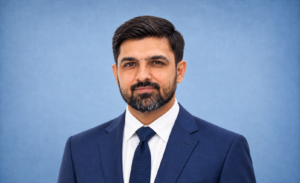
As technology transforms how businesses build and scale, access to exceptional engineering talent has become a strategic advantage. In this conversation, Furqan Aziz shares how InvoZone is connecting Pakistan’s technical talent with global demand, combining speed, rigorous engineering, flexible engagement, and AI-native capabilities to deliver world-class technology solutions.
Boardroom: What inspired the creation of InvoZone?
Furqan Aziz: My journey started with a simple ambition: to build something meaningful and create an organization that could compete beyond Pakistan. Coming from Hasilpur, I understood that building a global technology company would require patience, capital, experience, and repeated learning. After exploring several ventures between 2014 and 2019, InvoZone finally took shape around a clear conviction: Pakistan has the engineering talent to deliver world class software if that talent is connected to the right structure, mentorship, and global opportunities. I also saw skilled engineers working in isolation, without access to the systems and international clients that could turn individual capability into sustainable business value. InvoZone was created to bridge that gap and build a human centric organization where talent, technology, and global demand could come together.
Boardroom: What business challenges are you solving through your technology services?
Furqan Aziz: Businesses often know what they want to build but struggle to find the engineering capacity and specialized expertise to build it quickly. Conventional hiring can take months, while off the shelf software may force companies into workflows that do not fit their needs. InvoZone addresses this gap by providing access to a large pool of pre vetted engineers across major technology stacks, with matching and onboarding designed for speed. Our flexible engagement models allow clients to access the right expertise without carrying the full cost and complexity of building an equivalent internal team. Whether a client is launching an MVP, repairing a struggling platform, or modernizing legacy infrastructure, our objective is to shorten the distance between an idea and a product that reaches real users.
Boardroom: What differentiates InvoZone from conventional software development companies?
Furqan Aziz: Our differentiation is built around talent quality, speed, flexibility, and accountability. We rigorously screen engineers for technical capability, system design, and communication rather than simply focusing on availability. Clients can be matched with specialized developers quickly, while our time zone aligned model supports real time collaboration. We also give clients flexibility to engage a specialist for a short assignment or build a dedicated team for a longer-term requirement. Increasingly, our engineers work with modern AI tools to improve development efficiency while maintaining quality. Ultimately, the strongest evidence of our approach is the relationships we build, reflected in our reported 97% client retention rate.
Boardroom: How do you balance innovation with execution at scale?
Furqan Aziz: Innovation has to be tested before it is deployed. At InvoZone, senior engineers use internal R&D and internal projects to evaluate new tools and approaches. Once something demonstrates value in a real production environment, we integrate it into client workflows. Execution is maintained through disciplined agile processes, including two-week sprints, short feedback loops, and regular reviews of measurable output. This approach allows us to adopt new technologies without making clients the testing ground. For us, innovation and execution are not competing priorities; they are part of one continuous improvement cycle.
Boardroom: What role does AI play in your product engineering approach?
Furqan Aziz: AI is now embedded across our engineering lifecycle, from code generation and testing to debugging and product development. Our teams use tools such as GitHub Copilot, Cursor, Claude Code, and ChatGPT to improve efficiency. More importantly, we apply AI where it solves a genuine business problem. That includes LLM integrations, computer vision, agentic systems, predictive machine learning, and AI audits that identify opportunities to reduce manual work, control costs, and improve business performance. We see AI not as a separate specialty but as an increasingly fundamental part of how modern software should be engineered.
Boardroom: How do you build long-term partnerships with global clients?
Furqan Aziz: Trust is built through consistency. Clients need more than successful project delivery; they need a technology partner that remains responsive as their business evolves. Our time zone aligned delivery model supports real time collaboration, while our teams remain engaged beyond initial development for support, scaling, and future requirements. Our reported 97% client retention rate and average partnership of around two years are important indicators that relationships, rather than individual projects, are at the center of our approach.
Boardroom: What has been the biggest challenge in scaling a technology company?
Furqan Aziz: The greatest challenge has been maintaining consistent quality while growing rapidly. In the early days, it was possible to personally monitor projects and maintain close oversight. As the engineering organization expanded, that approach was no longer sustainable. Scaling required us to move from founder led oversight toward strong executive leadership, clearer processes, and specialized functions. Building dedicated Finance and Accounting capabilities, strengthening sales and revenue leadership, and establishing systems that allowed hundreds of engineers to work consistently became essential. The real challenge was therefore not simply hiring people; it was building an organization capable of delivering the same high standards at scale.
Boardroom: How do you see Pakistan’s software industry evolving over the next decade?
Furqan Aziz: Pakistan has demonstrated that its technology talent can compete internationally, and the growth of IT exports reinforces that opportunity. The next decade should focus on turning this potential into a durable industry. Talent development must become more closely connected to industry requirements. The sector also needs greater market diversification rather than depending heavily on the US and Europe. Expanding into markets such as Japan, Singapore, and the wider APAC region can create greater resilience. Finally, AI fluency must become a baseline capability. Companies that become genuinely AI native will be better positioned to compete globally.
Boardroom: What qualities define a world-class technology organization today?
Furqan Aziz: A world class organization combines speed with rigor, strong and genuinely vetted talent, flexibility, and the ability to adapt its engagement model to the client’s actual needs. Technology companies also need to demonstrate AI capability through everyday engineering practices rather than simply presenting it as a marketing message. Ultimately, world class performance comes from consistently delivering high-quality outcomes while remaining responsive to changing technology and customer expectations.
Boardroom: What is your long-term vision for InvoZone as a global technology company?
Furqan Aziz: Our ambition is to become the company businesses think of first when they need engineering talent they can genuinely trust. We have built a foundation across five global offices and more than 20 industries, and the next phase is about expanding both our domain expertise and technology capabilities. We want to provide businesses with access to top tier staff augmentation as well as full scale custom software development, supported by increasingly AI native engineering workflows. The goal is straightforward: to become a technology partner that helps businesses build faster, work smarter, and achieve a level of engineering quality that would be difficult to achieve through an equivalent in house team alone.